


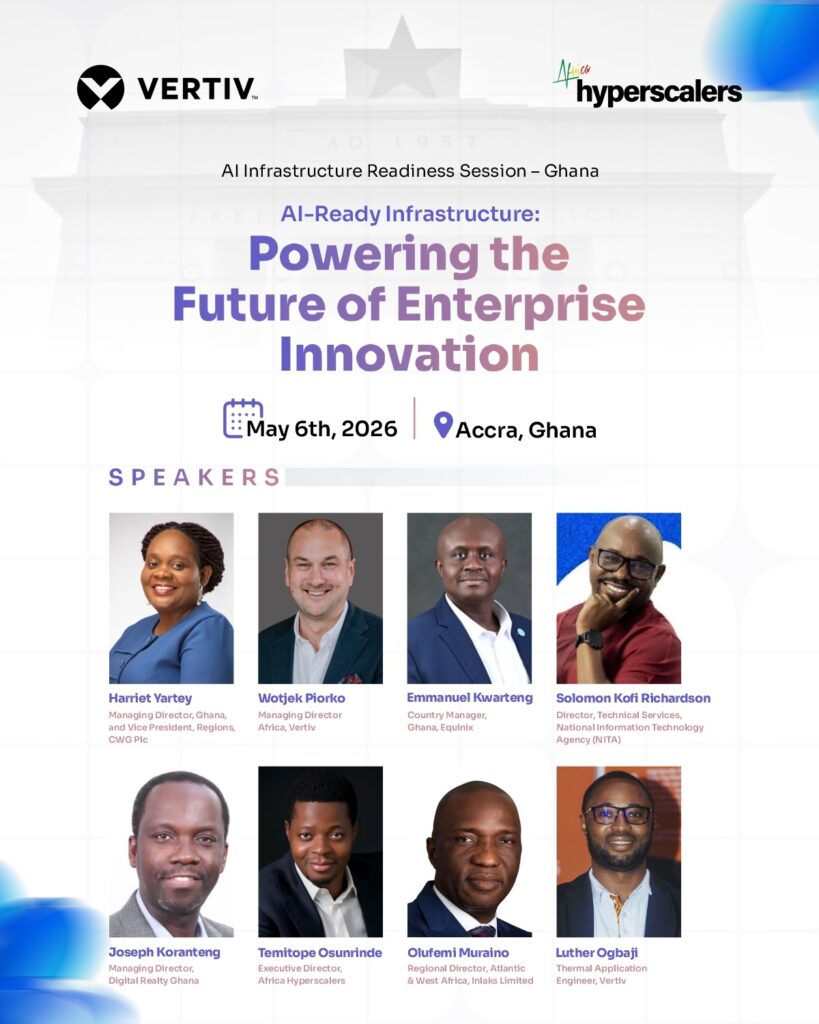

AI Infrastructure Readiness Session – Ghana
Theme:
AI-Ready Infrastructure: Powering the Future of Enterprise Innovation


Date: May 6, 2026
Time: 9:30AM GMT
Lancaster Accra Hotel, Liberation Rd, Accra, Ghana
Event overview
The AI Infrastructure Readiness Session – Ghana is a closed-door, high-level industry convening designed to assess Ghana’s readiness to support artificial intelligence at scale and identify the infrastructure required to power the country’s next phase of enterprise innovation.
As AI adoption accelerates globally, infrastructure has emerged as the primary constraint. Across leading markets, the conversation has shifted from connectivity expansion to compute capacity, power availability, interconnection ecosystems, cloud architecture, and data sovereignty frameworks.
Despite strong progress in mobile broadband, digital financial services, and enterprise digitization, Ghana’s ability to process, host, and scale AI workloads locally remains limited. At the same time, regulatory signals – particularly from the Bank of Ghana – are increasing demand for domestic hosting and on-premise infrastructure for critical financial systems.
This session brings together stakeholders across government, telecoms, data centers, financial services, academia, and infrastructure platforms to address a central question:
Is Ghana ready to support AI at scale – and if not, what must change?
Why This Session Matters
Ghana has built a strong connectivity foundation supported by operators such as Csquared, Vobiss, MTN, Telecel, and PPL,alongside several other operators.
The country’s data center ecosystem is also evolving, with infrastructure investments from PAIX Data Centres, Equinix (MainOne), Onix, and Digital Realty signaling growing market confidence.
However, AI-ready infrastructure – including high-density compute environments, resilient power systems, advanced cooling architectures, and deeper interconnection ecosystems – remains at an early stage.
As enterprise demand shifts from connectivity-led growth to compute-intensive workloads, Ghana’s ability to scale local hosting capacity, strengthen energy systems, and align policy with infrastructure realities will determine its position in the next phase of the digital economy.
Session Objectives
The session will deliver a structured assessment of Ghana’s infrastructure readiness across four priority areas:
- Infrastructure readiness assessment
Evaluate current capacity across data centers, connectivity networks, hybrid cloud adoption, and interconnection ecosystems. - Gap identification
Highlight constraints affecting AI deployment, including compute availability, power reliability, regulatory alignment, and enterprise adoption readiness. - Stakeholder coordination
Align government institutions, telecom operators, cloud providers, financial institutions, and academia around shared infrastructure priorities. - Action roadmap development
Define interventions for scaling AI-ready infrastructure nationally
Key Discussion Themes
Building AI-ready infrastructure
As enterprises and governments embrace artificial intelligence and high-performance computing (HPC), they must rethink their core infrastructure to support the unique demands of AI workloads. This includes preparing for dense compute environments, increasing processing capacity, and ensuring data flows seamlessly across core, edge, and hybrid environments. The session will feature an innovation showcase from Vertiv and examine how hybrid infrastructure models thatcombine on-premises systems, colocation facilities, and cloud platforms can scale in Ghana.
Data Centers, Compute and Connection Capacity
Local data center infrastructure will determine Ghana’s ability to support enterprise AI workloads, meet compliance requirements, and position itself as a regional compute hub for West Africa. Its next-generation infrastructure performance depends on metro fiber depth, IXPs, and localized traffic exchange. Strengthening interconnection ecosystems will reduce latency and keep more traffic within the country and region.
Policy, Compliance, and Data Sovereignty
Regulatory expectations around data protection and localization - particularly in financial services - are shaping infrastructure investment decisions. The session will explore how policy can align with infrastructure capacity to support innovation while ensuring compliance.
Who should attend
The session is designed for senior decision-makers shaping Ghana’s digital infrastructure and enterprise technology landscapeto share insights, innovations, and strategies for building future-proof digital environments.
- Government officials and regulators shaping digital economy policy
- CEOs, CIOs, and CTOs across financial services, telecoms, oil and gas, and enterprise platforms
- Data center, cloud, and colocation operators
- Connectivity and fiber infrastructure providers
Participation is limited to ensure a focused, high-impact dialogue among leaders directly responsible for infrastructure strategy and deployment.
Speakers

Wotjek Piorko
Managing Director Africa, Vertiv

Solomon Kofi Richardson
Director, Technical Services
National Information Technology Agency (NITA), Ghana

Harriet Yartey
Managing Director, Ghana, and Vice President, Regions,
CWG Plc

Emmanuel Kwarteng
Country Manager, Ghana,
Equinix

Temitope Osunrinde
Executive Director
Africa Hyperscalers

Joseph Koranteng
Managing Director,
Digital Realty Ghana

Olufemi Muraino
Regional Director,
Atlantic & West Africa, Inlaks Limited

Luther Ogbaji
Thermal Application Engineer, Vertiv

Okechi Osuagwu
Regional Account Manager Sales, Vertiv

Sofiat Ojurongbe
Regional Strategic Account Manager,
Vertiv

Olajide Aminu
Regional Strategic Account Manager - Central Africa,
Vertiv

Maxwell Ababio
Head of Technology and Ethics,
Data Protection Commission (DPC) of Ghana

Oluwasayo Oshadami
Director,
Solutions Architects (West Africa)
Equinix.

Patrick Munis
Founder and CEO
NewWave Holdings

Olajumoke Rufus
Marketing and Communications
Vertiv

Sofiat Ojurongbe
Regional Strategic Account Manager,
Vertiv